Between Programs
A Service Design Project
The Challenge
For my service design case study in UX112, my team and I looked at one of the least examined processes at Laurier: what actually happens when a student changes their major.
Students switch programs for ordinary reasons — new academic interests, struggling with coursework, realizing the field doesn't line up with their career goals. What makes it hard isn't the decision. It's everything after it. The process is emotionally loaded, and it's spread across advising appointments, MyDegree, LORIS, the Academic Calendar, faculty review queues, and the registrar, with no single place explaining how any of it fits together.
We mapped who carries that weight. First and second-year students worry about program requirements, graduation timelines, and what steps to take. Upper-years face steeper costs: new prerequisites, a delayed graduation, and the financial consequences of extending their degree. On the institutional side, academic advisors, the registration office, and departmental faculty each own a piece of the process — which is exactly why nobody owns the student's experience of it.
Mapping the System
Instead of jumping to a fix, we built two artifacts to make the whole system visible.
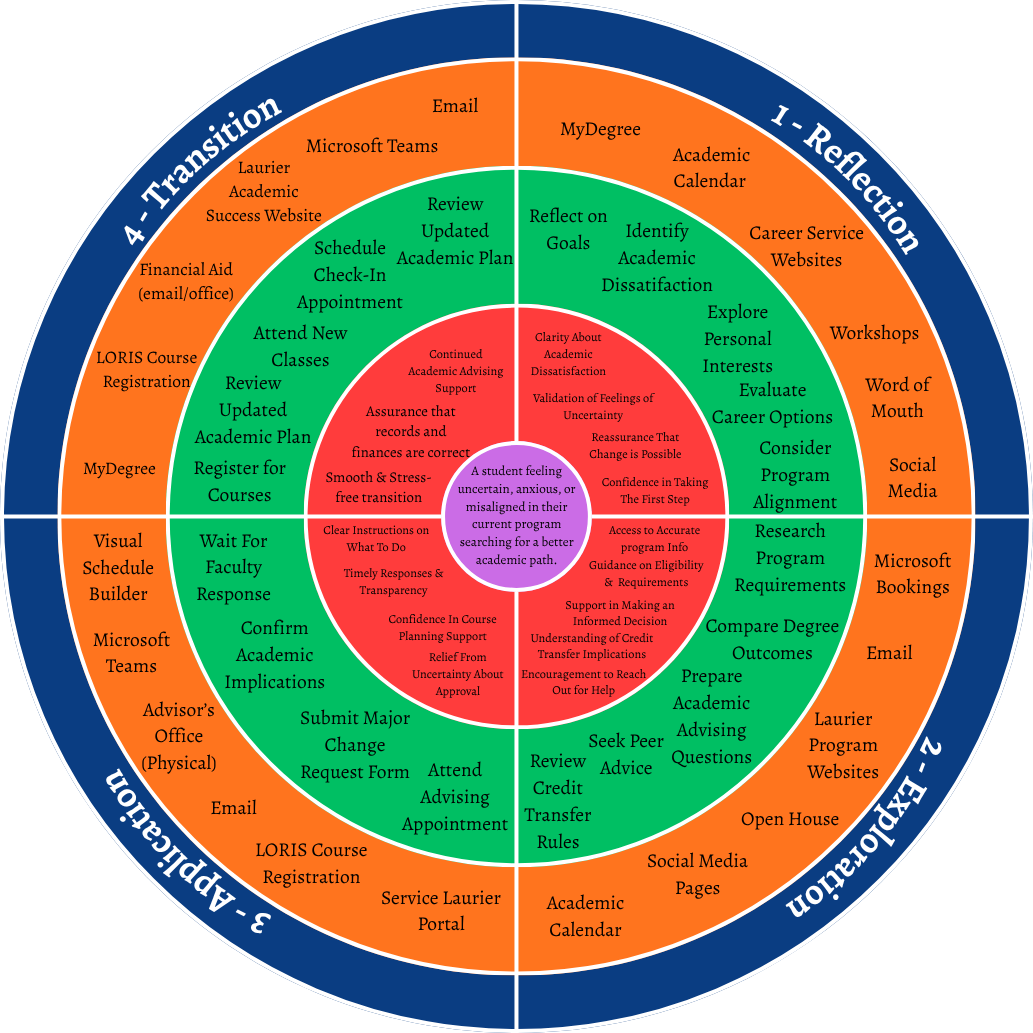
Our service ecology map plotted the four phases — Reflection, Exploration, Application, Transition — against every channel, interaction, and need at each stage. At the centre, we placed the one thing driving all of it: a student feeling uncertain, anxious, or misaligned in their current program, looking for a better academic path. Every outer ring is something the institution offers. That centre is what the student actually needs.
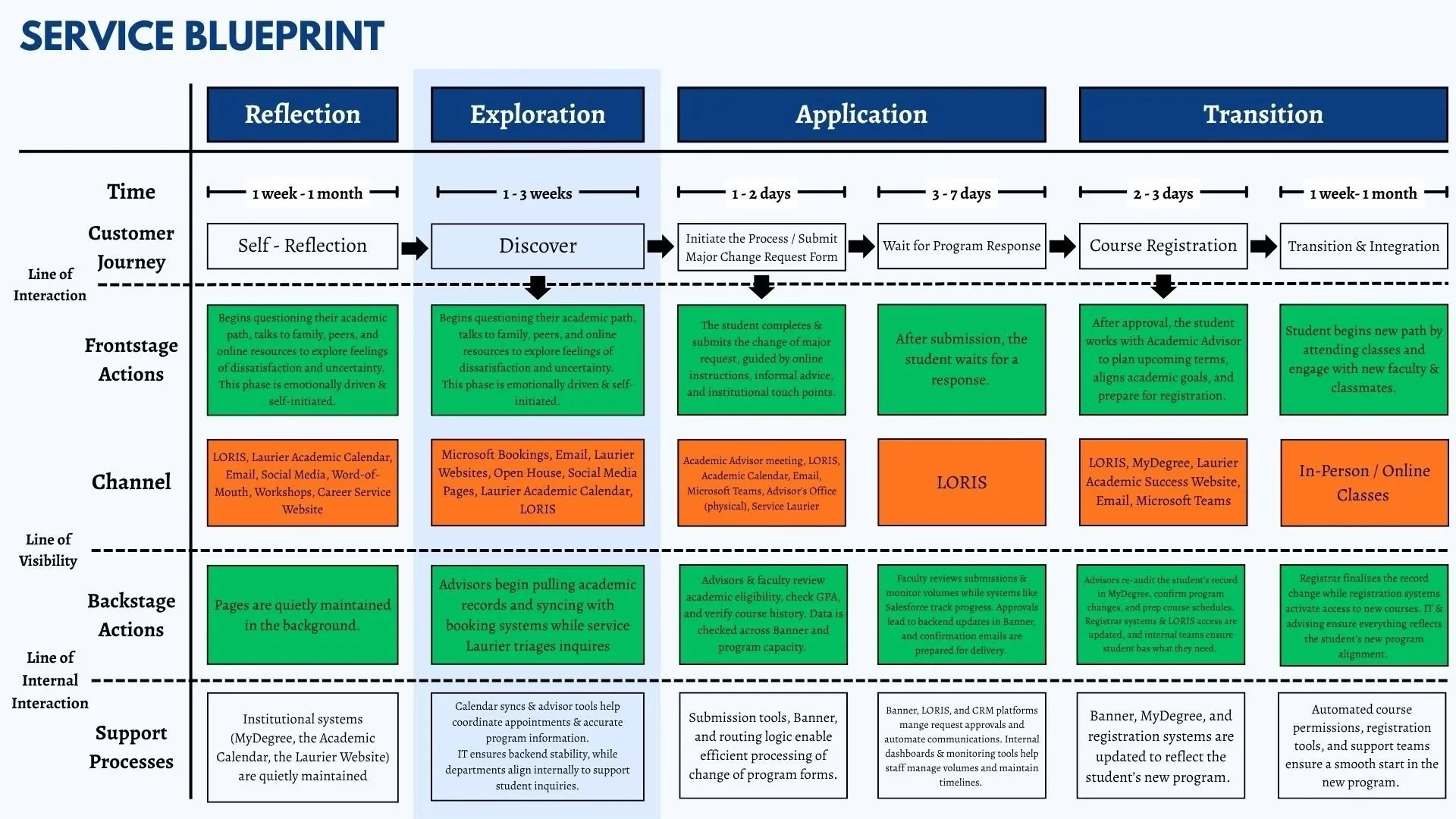
We then built a service blueprint breaking each phase into customer journey, frontstage actions, channels, backstage actions, and support processes, with realistic timing. Laid out that way, the timeline speaks for itself: one week to a month of self-reflection, one to three weeks exploring options, then three to seven days waiting on a faculty response with no visibility into what's happening. The blueprint let us see the backstage work — advisors pulling records, faculty checking eligibility across Banner and LORIS — and showed exactly where the student is left staring at nothing.
Grounded in service design research from Baranova and Polaine, five pain points came out of it: no centralized guidance, concentrated stress in the Exploration phase, communication delays, confusion from juggling multiple platforms, and the emotional toll of uncertainty running underneath all of it.
The Proposition

We proposed a Centralized Program Change Portal: one place with step-by-step instructions, side-by-side program comparisons, and direct links into MyDegree, LORIS, and Microsoft Bookings.
The value isn't new functionality. Every one of those systems already exists — the portal just stops students from having to assemble them alone. It targets the phase our blueprint showed was worst, and gives students a way to feel informed and in control during the stretch where they currently have neither.
We scoped implementation honestly rather than pretending it was free. Front-of-house, advisors and Service Laurier would need minimal training, communication support, and promotion. Back-of-house is the real lift: integration with Banner, LORIS, and Qualtrics, with the status tracker carrying the heaviest technical cost. Naming that upfront is what separates a service proposal from a wish.