The Wellness Hub, Rebuilt
Making campus support easier to reach than to avoid
Phase one: Research
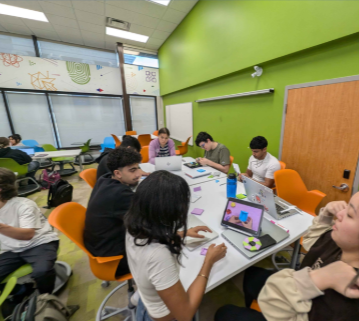
We were given a client and a question, not a solution. Claire runs the Wellness Hub at Laurier Brantford — a space with a ball pit, fidget toys, massage chairs, and a breakfast bar — and students weren't using it the way she'd hoped. Our brief was to answer one thing: how might we enhance wellness service accessibility for Brantford students?
We ran three methods in sequence, each answering a different kind of question. Observations told us how many students actually came through the doors and how long they stayed. Contextual inquiry put us inside the space to understand why it felt the way it did. Interviews with nine students — three managing high stress and full course loads, six with lower stress — gave us the lived experience behind the numbers.
What surfaced wasn't one problem but two overlapping ones. On Claire's side: fidget toys going missing, a ball pit nobody could keep sanitized, and a service run almost entirely by one person. On the student side, something more subtle. The ball pit and fidgets had been locked away in response to the theft, which meant the most visible reasons to visit were gone. Students described feeling exposed walking into a glass-fronted room. Several said they hesitated to take resources because someone else might need them more. Almost none could describe what the Hub actually offered, and the website hadn't helped.
We benchmarked against Waterloo, McMaster, Guelph, Concordia, and UBS to see what peer institutions were doing, then synthesized everything into four personas — the Anxious Adventurer, the Nervous Homebody, the Relaxed Learner, and the Calm Explorer — and a journey map tracing a student from recognition that they're struggling through awareness, motivation, self-reflection, and finally commitment to returning.
Phase 2: Ideation
Research gave us five possible directions: private versus public space, on-the-go services, a physical redesign, new creative programming, and additional tools and resources. We had one semester, and the Hub was already scheduled to move locations — which quietly ruled out anything depending on the current floor plan.
We narrowed our focus to two personas whose needs pulled in opposite directions. The Anxious Adventurer wants a welcoming entrance and comfortable atmosphere; they'll speak up about what they need. The Nervous Homebody wants clear signage and no obligation to socialize; they prefer privacy and stay reserved. Designing for both produced our core insight: students need a solution that brings mental health support into daily life and meets them where they already are — at home, in class, wherever.
We ran sketch sessions and a Now / How / Wow matrix to sort ideas by originality against feasibility. Welcome signage, social media, and flyers were achievable but unremarkable. Sleeping pods and a full spatial redesign were compelling but impossible inside our timeline. Craft bags landed in the Wow quadrant — original and buildable — and they solved the accessibility problem directly by removing the need to enter the space at all.
Phase 3: Prototyping
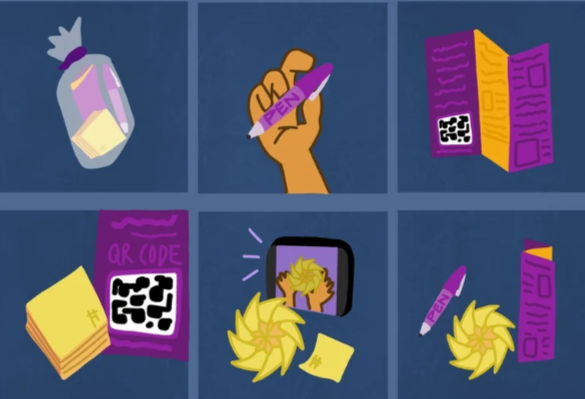
The bag was built around three principles drawn straight from our personas: privacy, since it can be used at home; openness, since every bag carries complete information about the Hub; and expediency, since taking one requires nothing more than reaching out a hand.
We prototyped the table setup at two locations, illustrated the full bag contents, and designed a testing plan covering feedback sessions with both persona types, observational testing in the real space, follow-up interviews a week later, and engagement tracking through punch card returns.
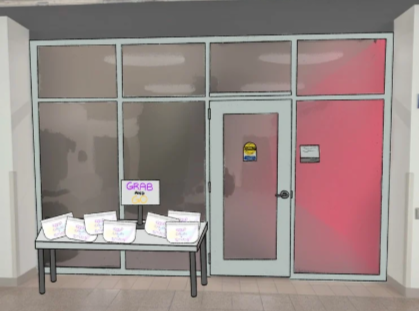
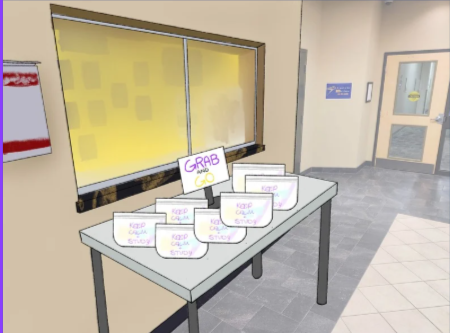
We built the Grab and Go craft bag: a sealed pouch a student could pick up from a table outside the Hub and take with them, no conversation required.
Each item was chosen against a second matrix plotting stress reduction against time commitment — anything that raised stress or demanded too much time was cut. What stayed: origami paper and a step-by-step manual, a pen, earplugs, a tea bag, a granola bar, a business card, a punch card offering a reward after six completed crafts, and a pamphlet with a QR code linking to video instructions and full Hub information — services, event calendar, hours, and emergency contacts.